Showing posts sorted by date for query best portrait photographer. Sort by relevance Show all posts

Monday, January 13, 2025

Women Artists of the DMV - All that you need to know!

WOMEN ARTISTS OF THE DMV

Describe the organizing principle(s) of the exhibition.

The “elevator pitch” or how I would describe the project in 30 seconds.

·   Me talking: This exhibition will be the first ever survey of female visual artists from the DMV (“local” acronym for District, Maryland and Virginia – or the Greater Washington, DC Capital region) ever done – it will be staged in six seven eight nine eleven fourteen fifteen major art spaces in 2025 in each state area bordering the District: they are the American University Museum at the Katzen Arts Center at American University in DC, The Athenaeum in Alexandria, and The McLean Project for the Arts, both in Virginia; and Artists & Makers Galleries and the Galleries at Strathmore Mansion, both in Rockville, Maryland, Pyramid Atlantic Art Center in Hyattsville, MD, The Writer's Center in Bethesda, MD, and the Montpelier Arts Center in Laurel, MD, Maryland Hall in Annapolis, the University of Maryland Library at College Park, MD, the Adah Rose Gallery in Rockville, the Joan Hisaoka Gallery in DC, the Melissa Ichiuji Gallery in Virginia and the National Children's Hospital Galleries in Washington, DC!

Project genesis, its development and its relevance today.

The Greater Washington, D.C., capital region (the DMV) is not only home to some of the best art museums in the world, dozens of commercial art galleries, non-profit art spaces, alternative art venues, and art organizations, but it also supports and fertilizes some of the best and most creative visual art scenes in the nation.

Celebrating this art scene, which spreads across the three areas that make up the DMV, local DC area curator, artist, and arts activist Florencio Lennox Campello (that's me again in fancy words) proposed in 2023 to curate an exhibition of 100-150 works by 100-150 women artists comprised of both leading and established female artists plus talented emerging contemporary female visual artists who represent the tens of thousands of women artists working in this culturally and ethnically diverse region in order to assemble a group show to showcase the immense power of the visual arts being created by these artists.

In late 2024, led by the American University Museum at the Katzen Arts Center in DC, and as part of the generous Alper Initiative, five other DMV art venues agreed to co-stage the show, which will run the six nine separate art spaces starting in September 2025 for 6-12 weeks. 

Three days after its announcement, over 1,000 entries came in (and are still coming), delivering empirical proof of the depth, diversity, and range of the of the exhibitions. As the date of this post, nearly 3,000 entries have been received.

In an effort to be more inclusive, the mechanics of the exhibition were revised to be able to archive and exhibit in some manner or form all the artists. This will be accomplished as follows:

  • All artists will be documented for the Smithsonian Art Archives as follows: A flash drive which would contain a PowerPoint presentation documenting all 3,000+ female artists who (so far) submitted art for consideration, and one image per artist.  Additionally, in view of how fast technology ages, the documentation will also include a digital screen device (a digital frame) to “play” the PowerPoint presentation as needed in the future.
  • The referenced PowerPoint presentation will be projected onto the walls of the Katzen Museum at American University during the duration of the exhibition (September through October 2025).

About the participating artists.

At this point, we have over 200 250 300 female artists selected for the six, seven eight nine fourteen fifteen venue exhibitions, which will include 2D, 3D, video, and performance art. Others may be selected on an ongoing basis, after studio visits, artwork review, etc. As of the date of this post, review is still ongoing - if you are a female artist from the DMV and wish to be reviewed, simply send an email with your website and/or Instagram feed to lenny@lennycampello.com - All reviews will end April 30, 2025.

How to enter or be reviewed

DEADLINE PASSED! Simply send an email with your website and/or Instagram feed to lenny@lennycampello.com by April 30, 2025.

How were they selected, by whom, why, what work will they be showing?

Who: The artists are were being selected by Florencio Lennox Campello, a well-known and respected DC area artist, curator, writer, and artist (that's me again). A DC area resident since the late 80s, Mr. Campello was once described by the Washington City Paper as “one of the most interesting people of Washington, DC.”  In 2011 he authored 100 Artists of Washington, D.C. (Schiffer Publishing, Atglen, PA), and his art blog, Daily Campello Art News is ranked among the top 15 art blogs in the world and has received over seven million visits over the last 20 years.

Deadline: April 30, 2025

Why me? Few people know the DC area art scene like Campello. Over the last few decades, he has curated or organized over 200 visual art shows. Furthermore, he has ample experience organizing and curating shows of this large scale.

He has the proven background and experience to curate large, multi-space art survey exhibitions. In 2007 he curated “Seven”, a seven-gallery exhibition across various spaces in Washington DC that surveyed the thousands of artist members of the Washington Project for the Arts (WPA)/Corcoran. Over 6500 slides (remember slides?) were reviewed by Campello and a nearly a hundred artists selected for the multi-gallery show, which received multiple reviews in the press, both local and national.  Earlier, in 2001 Campello curated “Contemporary Realism: A Survey of Washington Area Realists” for the Athenaeum in Alexandria – another show that exhibited over 60 artists and received wide reviews in the regional and national press. 

Furthermore, as he has previously done with great success, Campello has engaged a variety of Greater DC area visual arts curators, gallerists and collectors to “crowd source” portions of the exhibitions; each person will nominate anonymously up to 10 artists for consideration to be included in the show.

Why this show? To survey the key, established female artists of the Greater Washington, DC region, mid-career artists, and just as important, identify the emerging female artists who can benefit from this exposure.  Additionally, as done in previous curated shows, Campello has approached and received the commitment of several Greater DC area gallerists, museum curators, and collectors to attend several guided tours of the exhibitions.  The goal here is to force the exposure of these artists to some of the key members of the city’s visual arts tapestry.  This is a proven process for success; for the previous “Seven” multi-gallery show, 28 of the artists were offered representation and/or solo gallery shows as a result of the exposure in the exhibition.

What work will they be showing?

All genres of the visual arts will be considered, to include public art. Each artist will have one work selected by the curator. Repeat: Each artist will have one work. Each artist will be assigned one of the six 14 15 venues to exhibit their selected work. It is the responsibility of the artist to prepare the work, deliver it to the assigned venue by the assigned date (to be announced later this year), and fill out the specific venue forms to document the work. It is also the artist's responsiblity to pick up the work after the exhibition at the venue.

Can work be sold?

Work can be for sale at all venues EXCEPT the Katzen Museum at AU. Each venue has a site specific agreement with commission details, etc.

Presentation standards

All selected work must be presented to full professional gallery/museum standards: Unless otherwise designed to hang (such as textiles), 2D work (drawings, watercolors, photographs) must be framed and if needed under glass/plexi. Work on canvas can be "gallery dressed" at the edges. Frames cannot be scratched or otherwise not presentable for a professional exhibition.  Most venues require the use of hanging wire (not stiff ordinary wire) and do not allow sawtooth hangers.  No acidic mats, saw tooth hangers or acidic backing on framed work will be accepted for exhibition. Address any and all presentation standards questions to lenny@lennycampello.com 

Artwork Delivery & Pick Up

Artists selected to exhibit are responsible for both delivery of art to the assigned venue and for pick up after the exhibition closes.  Each venue has its own assigned date(s) and exhibition agreements/contracts which exhibiting artists will sign when art is delivered. Note that most venues can have the art for sale and if sold will have a commission. Also please let it be clear that the exhibition portions of this survey show is between the artist and the exhibiting venue and not the curator.

How will participation in this show help to further their career and/or creative practice?

Exposure – As noted earlier, the curator will coordinate both group and individual walk-throughs of the exhibition with key DC area curators, collectors, gallerists, etc. This is a proven tactic to get artists, especially emerging artists, noticed.

Expanding the footprint - So far, the curator has secured intentions to cover the exhibition by multiple DC area news organizations such as The Washington Post, NPR, two local radio stations, and one local TV station.  More are being cultivated at all times.

Boot camp for artists – As part of the process, participating artists will be invited to participate in the curator’s “Boot Camp for Artists” seminar, a 4-hour free seminar which over the last 30 years has been presented to over 6000 artists and arts professionals. The seminar is designed to deliver information, data and proven tactics to allow artists to develop and sustain a career in the fine arts.

1. Materials - Buying materials; strategies for lowering your costs, where and how to get it, etc.

2. Presentation – How to properly present your artwork including Conservation issues, Archival Matting and Framing, Longevity of materials, a discussion on Limited editions, signing and numbering, Prints vs. Reproduction, discussion on Iris Prints (Pros and Cons).

3. Creating a resume - Strategy for building your art resume, including how to write one, what should be in it, presentation, etc.

4. Juried Shows – An Insider's view and strategy to get in the competitions.

5. How to take images of your artwork

6. Selling your art – A variety of avenues to actually selling your artwork, including art fairs, outdoor fine arts festivals, corporate acquisitions, galleries, public arts, etc.

7. Creating a Body of Works

8. How to write a news release

9. Publicity – How to get in newspapers, magazines, etc. Plus, handouts on email and addresses of newspaper critics, writers, etc.

10. Galleries – Discussion on area galleries including Vanity Galleries, Co-Operatives, Commercial Galleries, Non-profit Art spaces, etc.

11. How to approach a gallery – Realities of the business, Contracts, Gallery/Artist Relationship, Agents.

12. Outdoor Art Festivals – Discussion and advice on how to sell outwork at fine arts festivals, which to do, which to avoid, etc.

13. Resources - Display systems and tents, best juried shows and ones to avoid.

14. Accepting Credit cards – How to set up your art business.

15. Grants – Discussion on how to get grants in DC, Regional and National, including handouts on who and where and when.

16. Alternative Marketing - Cable TV, Local media

17. Internet – How to build your website at no cost, how to establish a wide and diverse Internet presence.

18. Art fairs - A strategy on how to participate in gallery art fairs

Information as about the catalogue and book.

American University will publish a catalogue about the artists selected to exhibit at the Katzen Museum. Each artist whose work is exhibited at the Katzen will have an individual essay written about their work and a large image of their selected work.

Additionally, the curator is currently negotiating with Schiffer Publishing for the publication of a hard cover art book to include 100 of the selected artists in the large format book. Each artist will have an individual essay written about their work and a large image of their selected work.

Update: Schiffer Publishing has decided not to go forward with the book proposal.

Here’s a sample chapter:

In 2022 was my distinct and unique honor to serve as the 2022 Paint the Town juror for the Montgomery Art Association, which together with the town of Kensington, Maryland stages an annual visual art exhibition and competition in the city’s ample Town Hall and on the streets of beautiful Kensington, just outside of the District of Columbia.   

As all great shows are, this was an immeasurably difficult show to judge, which is a good thing! The quality of entries was uniformly superior in almost every category, and the difference between first, second, third, and even some honorable mentions was minimal.

It was at this show that I was first astounded by the paintings of Dora Patin, who ended up winning “Best in Show.

I do not throw around the word “astounded” easily. Over the last four decades I’ve seen the work of hundreds if not thousands of artists who just started painting a few years ago, and already deliver immensely intelligent work.

Patin smokes them all – in fact, I think that Patin is a painting prodigy.  She has only been painting for a handful of years, and yet her trompe l’oeil paintings are breathtaking in their ability to fool the eye.  Either Patin has painting super powers or owns the most enviable painting learning skills on a planetary level.

Over those same decades I have seen many artists who, after decades and decades of practice, failures and successes, have accomplished the spectacular technical painting skills of this artist, but none, zero, not one, in such a short time after first grabbing a painting brush and opening a paint tube.

And technical painting skills alone do not make great art, and this is where Patin’s natural skills assist her in also delivering intelligent compositions and works full of psychological storylines – such as her series on some of the “key” hands of the poker game, or “Alice.”

Breathtaking technical skills in the hand of an intelligent artist are formidable art assets.

Who is writing?

The curator, Florencio Lennox Campello is writing both the Katzen Museum exhibition catalogue, and the Schiffer Publishing large format art book.

What are the essay topics?

Each artist in both the Katzen catalogue and the book will have an individual essay written about them and their work – here is another example:

Lida Moser

Lida Moser remains the greatest photographer whom I’ve ever met in person.

She was once called the "grandmother of American street photography" by an art critic, which prompted a quick rebuttal by Moser, who called the writer's editor and told him that she wasn't the "effing grandmother of anything or anyone, and would he [the writer] ever describe Ansel Adams or any other male photographer as the 'grandfather' of any style’."

Moser was born and lived most of her life in New York City, but a couple of decades ago moved to our area and was immediately adopted by the DC area art scene. 

Judy and The Boys by Lida MoserLida Moser's photographic career started as a student and studio assistant in 1947 in Berenice Abbott's studio in New York City, where she became an active member of the New York Photo League. She then worked for Vogue, Harper's Bazaar, Look and many other magazines throughout the next few decades, and traveled extensively throughout the United States, Canada and Europe. 

She also authored and has been part of many books and publications on and about photography. She also wrote a series of "Camera View" articles on photography for The New York Times between 1974-81.

Her work has been exhibited in many museums worldwide and is in the permanent collection of the National Portrait Gallery, London, the National Archives, Ottawa, the National Galleries of Scotland, National Portrait Gallery, Washington, DC, the Library of Congress, Les Archives Nationales du Quebec, Corcoran Gallery, Phillips Collection and many others. And one of her most iconic photos, depicting of the window washers cleaning windows at the Exxon Building in NYC was actually made into a 3D sculpture at Legoland (without Moser's permission) in Florida.

She wielded her camera like a weapon, and her photos are gritty, full of life, city narratives, police sirens, and stories of all kinds and flavors – like Lida.

Will the catalogue document or expand upon the exhibition’s premise?

Both the catalogue and book will both document and expand upon the exhibition’s premise. Both of them will be archived by the Smithsonian Institution.

Specific opportunit(ies) for the artists: residencies/performances/public programs.

  • For many of these artists, this may be their first-ever exhibition in a museum as well as their first cataloguing in a book or museum catalogue.
  • For nearly all of these artists, this will be their first exposure in a major national review outlet such as The Washington Post, NPR, etc.
  • As the curator has many inside connections with DC area galleries, this will also present these artists with their first ever opportunity to be exposed to a curator, to a collector and to a gallerist.
  • Most of these artists will also (for the first time) be exposed to Art Bank – this is the DC Commission on the Arts & Humanities Commission process to acquire art for the city’s collection; coordination with the DC Commission on the Arts & Humanities Commission is ongoing to secure a commitment from the commission to review the shows with the goal of acquiring some of the work for the City’s collection.
  • The curator is also coordinating with the National Museum of Women in the Arts to conduct a curator visit to the four venues, and select at least one work for acquisition and addition to the permanent collection of the museum. Similar seminal coordination is ongoing with several local universities, with the goal being for them to acquire a work from an exhibiting alumni artist for the permanent collection of the university.
  • All artists will be invited to attend the “BootCamp for Artists” seminar, to be staged at American University, at no cost to the artists.

Saturday, November 12, 2016

Artomatic 2016: The Review

Artomatic, the planet's greatest open visual arts show is back, this time in Montgomery County, Maryland, which is part of the Greater Washington, DC area, or as I dubbed it over a decade ago, the DMV (District-Maryland-Virginia).

And, because this is the smallest Artomatic ever (by Artomatic standards anyway) since it only has about 380 artists, it is perhaps the easiest to see, since it would only require 2-3 visits to see all the artists on the 5th and 6th floor of the Park Potomac building where it is being staged.

I'll start with work that caught my eye, my usual Artomatic "Best Awards" and finish it with my top ten picks, perhaps the hardest job that any art critic, or opiner on the arts ever has, since the trite saying "art is in the eyes of the beholder" has never been more applicable than after a visit to any Artomatic.

I'd also like to brag that (as many of you know) many of my past Artomatic Top Ten picks have gone on to become recognized, blue chip artists around the DMV; and some, such as Tim Tate, around the nation, and some, such as Frank Warren around the planet! 

On the 6th floor I liked the paintings of William Tinto (great deals by the way - all around $300-$400), Nils Lofgren, Nancy Abeles and Praveen Thaivalappil. I also liked some very unusal paintings by Yumiko Hirokawa - I note "unusual" because they're on a substrate of aluminum paint and boast superb technical skills (as do all the previously noted painters) with a hard-to-pin-point sense of macabre to them. I also liked Joyce McCarten and Laurie Breen. I also liked the works of Chris Meer, who is unknowingly channeling Anne Cherubim and should probably meet her and see her paintings on the same floor!

I also liked Doug Stern and Roger James. Their locations on the 6th floor, next to each other is artist placement genius... enough said, you'll have to go see it to ... cough, cough... see what I mean.

On the 5th floor I liked the sculptures by Daniel Aaron Stuart, and many other artists which are mentioned below.

And now, the awards!


Artist Most Likely to Attract Gallerists: Kathy Lindert... I can't find a website for her, so I'm assuming that this talented painter is unrepresented... Get a website!!

Best Naive Art: Schroeder Cherry - this artist, located close to the elevators on the 5th floor, initially fooled me into thinking that he was a self-taught artist (he's not), until on my third visit to his booth, I did a closer examination of his works, and realized that he's perfectly accomplishing one of the most difficult tasks in the visual arts, which is to use a naive visual approach to deliver intelligent and resonant works of social commentary and narrative complexity. Cherry focuses on African-American themes that reflect powerful imagery, augmented by striking presentation (chopped frames, etc.), found objects, etc.


Angel Can #42 by Schroeder Cherry
Best Animal Art: Sandra Perez-Ramos - She also gets the "Coolest Use of Pocket Protectors" award.

Best Mono-Chromatic Art: Alex L. Porter - Impressive what Porter can do with just black and white.

Best Portrait Artist: George Carr - He also gets the "Best Figure Painter" award - not an easy double award to get in two very hotly contested categories!

Best Textile Art: Diane Tuckman - a master of the craft!

Best Wall 3D Art: Erin Antognoli - Amazing 3D piece, right on the wall by the side of the elevator.

Best Furniture Art: Daniel Good - Overtly busy paintings in the shape of furniture... Dude it is 2016: Get a website!

Best Illustration Art: Annie Lunsford - She also "illustrated" her booth's drywall! This was a highly competitive category, as there is a lot of high quality illustrative work in this iteration of AOM.

Best Installation: Liliane Bloom - Her "Pink - A Cherry Blossom Fantasy" is not only mesmerizing to the eyes, but also a perhaps unintended tip of the hat to DMV installation artist Dan Steinhilber.

Best Glass Artist: Sherry Selevan - Opaque and mysterious works that stand from the usual glass menagerie of bowls and vessels. She shares the award with Trish Kent's very cool fused glass dresses (get a website!!).

Best Erotica: Jenny Wallace - She runs away with this coveted award, although I must also add that this Artomatic doesn't have the usual large numbers of erotica as part of its roster of artworks. I also noted that most artists working erotic themes have been cleverly located in corners of the spaces, with the images usually facing away from the main walkways. Wallace also wins the "Sexiest Image Award" with her photo titled Resignation. Wallace could be the best fetish-focused artist that I have ever seen. The second place for sexiest image goes to Julia Mazur's photo of a nude woman sitting on a window sill. The image is back-lit and highlights every single hair on her body, each one seductively outlined by the light.


Photo by Julia Mazur

Best Erotic Fruits: Tara O'Neil - Her sliced peaches got me all fuzzy! 

Peach by Tara O'Neil

Best Flag Art: Blue Robin and Lindsey D. Vance share this award. Blue Robin's use of the coqui on the Puerto Rican flag is genius!

Best "I Already Knew He Was Good" Award: Ric Garcia

Best Technical Skill: Branch School of Art

Best Color Pencil Artist: Amanda Spaid - Wonderful control and intelligent employment of color - really, really good at a very difficult technique..

Best Clay Artist: Kasse Andrews-Weller - Busy and intelligent! Another artist without a website...

Best "Is it Abstract or Not" Award: Anne Cherubim is one of the most interesting painters around the DMV, and her dream-like paintings are deceptive images which showcase her formidable painting skills - they leave the viewer wondering as to the subject matter, while all along Cherubim has been hypnotizing them with her mastery of the subtle psychological effects of color!

Best Standing Stones Photography: Peter del Toro - I know, I know... pretty slim category, but I love standing stones imagery, and as such I read once that I was one of the world's top authorities on the subject (I wrote it, then I read it.. cough, cough), and therefore I know good when I see it, and del Toro's photos are really superb!

Best "Painterly" Cars (or is it "Best Car Painter"?) Award: Michael Kent

Best Mobiles: Rita Mortellaro - This is a spectacular departure for this award, which is usually the domain of someone channeling Calder. Mortellaro rocks this category with mobiles made out of tiny metal and/or fiber hoodies with rocks and found objects!

Mobile by Rita Mortellaro
Best Frida Kahlo Art: Marily Mojica - The Washington Post once called me a "Fridaphile" and I know my Fridas, and having curated two worldwide international homages to the Mexican icon, I really know artists working the Frida angle. And Mojica is easily one of the best that I have ever seen! Her approach is a clever re-invention of how we see Kahlo depicted (many times in her salon style hung booth).

Best Found Object Art: Seemeen Hashem... try to find it!

Is This Art? Award - Actually I have no idea is this is a sculptural installation, or just part of the construction on the floor, but it is kinda cool anyway! (see below image) Update: This installation is by artist Greg Braun!


Best "Better not have fallen asleep in Art History class" Award: Roger Cutler - This is not a surprise, as Cutler is a master of his genre, and his Duchamp's Bike Repair sculpture should be included in the next edition of Janson's!

Duchamp's Bike Repair by Roger Cutler

Best Action Painting: Kim Foley - One can almost feel the energy pop out of her works!

Best Bug Art: Emily Uchytil - Surprisingly, although not for most AOM's, this was a highly contested award! The very talented Uchytil also gets second place in the "Best Birds Art" category; she has enviable painting skills!

Coolest Idea Award: Victoria Thompson - In her booth "Object", this photographer takes old vintage photos and then modifies them, exposing breasts here and there; a clever depiction of the objectification of women.


Object by Victoria Thompson
Best Horror Vacui Award: Rachel Ann Cross - Elegant wall sculptures that employ guitars, etc. fully adorned in full kenophobic splendor!

Best Flower Art: Malathi Jayawickrama - Superb use of light and very painterly - this is one of the toughest categories at AOM, as there are many flower aficionados.

Best Record Keeper Award: Greg Benge - His "Vinyl Countdown" series is very attractive and could also get the "Recyclable Art Award." Benge notes that he "found a really great deal on hundreds of scratched unplayable discs (don’t worry, I haven’t ruined any rare finds)." For older readers: "disc" = "LP" or "record."

George Carlin by Greg Benge
Best Sculpture Award: Gloria Chapa - Her Placebo Pinata did it!

Best Encaustic Art: Marcie Wolf-Hubbard - easy pick when a master of the genre is in the show.

Best Art Deal Award: Suz Podrasky - At around $80 for original work that is intelligent and well presented - buy it! The award is shared with Rambo, Inc. on the 6th floor by the Artomatic office; they have artwork as low as $10 and it is superbly talented work. Also shared with Michael Auger; his very cool artwork can be acquired for around $50!

Best Steam Punk Art: Studio Detritus - They (Marcia and Randall Fry) also get the "Best Title Award" for Planck's Doorway 2!

Best Veggie Painter: Kathleen Carroll - Do not be deceived by the focus of the work; this is a really good painter!

Must See Award: Eeshan V. Melder - Do not miss the Eliot's Lunch installation and make sure that you read the wall text!

Scariest Painting Award Josh Gorsky - The angry mandrill did it!

Mandrill by Peter Sibrin
Angry Art Award: Artist Unknown - No name to the angry art with black fist and spent bullet casings.

Best Breast Award (try saying that three times in a row): Shanna Casey's ceramic vase, perhaps an homage to Günter Grass' The Flounder?

Breast ceramic vase by Shanna Casey

Best Student Art Award: Dionnia - From Holy Trinity Catholic School 7-2A class! Her use of color, and replay of the color on the ground, on the pyramids and in the sky is playful and attractive!

Untitled by Dionnia
Best Landscape Artist: Sarah Wardell - Elegantly muted plein air landscapes, where one can feel the sunlight and smell the grass.

Top 10 Artists (in alphabetical order)

Shiri Achu - Powerful African art in a marriage of contemporary skills with strong African imagery from this Africa-born new American artist.

Ralph Baden - His ridiculous paintings are over the top!

George Carr - Spectacular painting skills! A total master of the figure and of the portrait.

Shanthi Chandrasekar - Over the years she has developed her own style of painting that is almost magic in context.

Schroeder Cherry - Read what I raved about him earlier.

Ellen Cornett - A spectacular artist! I'm so jealous of her drawing skills!

Ric Garcia - Continues to invent and define a new genre of Latino pop art.

Glen Kesler - An easy pick... and I think that I've picked him before in previous AOMs!

Kathy Lindert - Get a website!

Phyllis Mayes - Another repeat pick for me - one of the best painters around the DMV.

Artomatic 2016 is on through December 9, 2016.


When?


November 3 – December 9


Thursdays:
Noon – 10:00 PM


Fridays & Saturdays:
Noon – 12:00 midnight


Sundays:
Noon – 6:00 PM


Closed Monday Wednesday & Thanksgiving Day


Where?


12435 Park Potomac Avenue, Potomac, MD 20854


Floors 5 & 6

Friday, November 04, 2016

Review of Artomatic 2004

This is a teaser of my review of Artomatic 2016, which is coming up after I make my third visit to the the show... can you pick how many blue chip artists have emerged from that AOM over a decade ago? Can you see why I like Artomatic?
Artomatic Energymatic Daggermatic

Art critics, like most writers, usually get paid by the word, sometimes by the article, and occasionally by an infinitesimal percentage of whatever profits their writing generates. And most art critics and writers visit a gallery show or museum exhibition, get a few handouts and spend about half an hour studying the works on the wall before heading home or to the office to pound the word processor’s keys and earn their buck-a-word for the review.

You can’t do that with Art-O-Matic, the huge, almost every two years, open visual arts extravaganza that this year hosted over 600 visual artists and another 400 performance artists at the laberynthic former convent building that last housed the Children’s Museum on 3rd and H Street, NE.

The idea behind Art-O-Matic is simple: find a large, empty building somewhere in the city; work with the building owners, and then allow any artist who wants to show their work help with staging the show and with some of the financial needs. This year, AOM artists paid a $60 entry fee plus worked a few hours assisting with the show.

And this year around 600 visual artists brought their art to the public.

In order to write a proper, ethical review of AOM, a writer must spend hours walking five floors of art, jam-packed into hundreds of rooms, bathrooms, closets and stairs. And I think that this is one of the main reasons that most art critics love to hate this show. It overwhelms them with visual offerings and forces them to develop a "glance and judge" attitude towards the artwork. It’s a lot easier to carpet bomb a huge show like this than to do a surgical strike.

Add on top of that an outdated, but "alive and kicking" elitist attitude towards an open show, where anyone and everyone who calls him or herself an artist can exhibit, sans the sanitizing and all-knowing eye of the latest trendy curator, and you have a perfect formula for dismissing a show, without really looking at it.

This quaint and elitist attitude towards art is not new or even modern. It was the same attitude that caused the emergence of the salons of the 19th century, where only artists that the academic intelligentsia deemed good enough were exhibited. As every art student who almost flunked art history knows, towards the latter half of that century, the artists who had been rejected from the salons (because they didn’t fit the formula of good art) organized their own Salon Des Refuses, sort of a 19th century Parisian Art-O-Matic.

And a lot, in fact, most of the work in the Salon Des Refuses was quite bad, but amongst the dreck were also pearls like Manet's Le Dejeuner sur 'Herbe (Luncheon in the Grass), Monet's Impression: Sunrise, (and we all know what art "ism" that title gave birth to) and an odd and memorable looking portrait of a young lady in white (The White Girl, Symphony in White, No. 1) by an American upstart by the name of James McNeill Whistler.

Everyone who was anyone in the art world hated and dismissed this anti-salon exhibition; except for the only "anyone" who actually counted: art history.

But then somewhere in the next century, the salons and their formulas returned. Only their name and their display styles had changed. They were now called Biennials, Biennales, Bienales, Documentas and their settings were in museums, entire cities or pristine white cubes around the world.

Only their reasoning and misguided logic remained constant: "Only we know what is good art."

And that is why these modern salonists and their acolytes will never respect, like, or understand Art-O-Matic: they recall that the Salons des Refuses almost broke their control over art; it won’t happen again.

And like the poet Marti wrote: "I know the monster well, for I have lived in its entrails." You see, over the last two decades I have been the juror, curator, decision-maker for hundreds of shows. And as a freelance art critic I have written and evaluated hundreds of artists and shows. I have been a minute gear in the world-wide machinations to keep control of what is art and never let a new Salons des Refuses wrest control again.

OK, OK, I know that am going overboard here; but... do you get the point?

But I am also an artist, and I like the concept of Art-O-Matic.

And not just because of the miles of artwork on display, much of which is mind numbing bad art; in fact, so bad that it is sometimes almost good in its exorbitant mediocrity. The main reason that I like Art-O-Matic is the palpable amount of artistic energy that it delivers to Washington, DC every couple of years. It is as if some invisible visual art battery in this ignored art scene comes to the forefront and gets recharged with brilliant white light (made as we all know, of all colors in the spectrum), and 50,000 people who generally would not set foot in a gallery or museum come and see art and artists and absorb the positive energy that only creative minds can generously give away.

So I enter my fourth Art-O-Matic with several preconceived ideas in my very subjective agenda:

(a) It’s going to take several visits and many hours to write my fourth review of Art-O-Matic in as many shows.

(b) There’s going to be a lot of dreck in the show. But art is in the eyes of the beholder; my dreck could be your pearl.

(c) I’m going to find several pearls in the show

(d) I’m going to re-charge my visual arts battery

(e) Our gallery will pick up some new artists from this show

On visit one, during the press preview, glass sculptor Tim Tate (Disclaimer: whom we represent and whom we "discovered" at a past Art-O-Matic) whizzes a group of us through the five floors of the show. It still takes three hours or so, but I have taken notes. Five visits and more than twenty hours later, I feel comfortable to start writing about the show.

A lot of the artists in the show are well known to me, and so I begin to discover "new" ones – at least new to me. Judy Jashinsky, who is one of the firebrand organizers who keeps this (and past) Art-O-Matics running, grabs me and asks me if I’ve seen Mark Jenkins’s pubic hair tapestries.

tape men by JenkinsAnd Jenkins is one of the first memorable discoveries in this show. Tucked away in a corner space, Jenkins has created two noteworthy entries into the show. First in everyone’s lips are his photographic explorations of close-ups of pubic hair (loupe included in the installation) that through the magic of digital manipulation become interesting designs of elegant abstracted qualities. A second Jenkins emerges from his crowded little room: the tape sculptures.

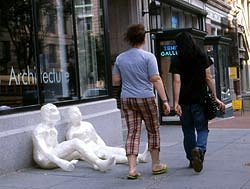
Jenkins uses common transparent packing tape (yards and yards of it) to create superbly crafted and visually attractive figurative sculptures, as well as the odd, unusual organic shaped one. Through documentary photography, we see what happens when Jenkins places these plastic figures in a public venue. A passing man stares incredulously at a plastic man inside a dumpster; or a beach jogger is surprised by an alien looking tape creature that the sea has washed ashore.

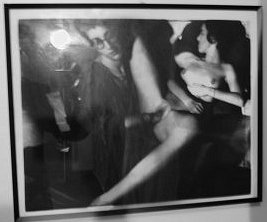
photo by Iver OlsonIver Olson is another talented discovery for me. He gets the award for the best porn in the show, although his display is also peppered with some otherwise just plain sensual photo-collages. It is almost as if there were two Olsons in the show: a really torrid, sensual photographer, and a brilliantly inventive pornographer.
In one of his photos, Olson has a woman with her hand buried inside the vagina of a second woman, who is sitting on a couch, seemingly bored, while her friend is searching inside her vagina, with (as an artist friend of mine put it) a "did a leave my keys in there?" sort of look. Somehow Olson has transformed the hardcore act of lesbian fisting into an almost funny scene of lustless abandon. Other good porn in the show is offered by Eduardo Rodriguez, Alexis Bine and Rudy K.

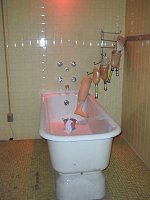
Another discovery is Ira Tattelman’s installation titled "They taught me to wash away my desires." I don’t know if it is because the building was once a convent, but there is certainly a strange, palpable energy in some parts of the building; people like Stephen King feed on this sort of energy and produce brilliant books; it is clear that Ira Tattelman also absorbed and channeled this energy into his installation. part of Ira's installation

"They taught me to wash away my desires" is inside a smallish bathroom furnished with a shower, a tub and some archaic 19th-century type bathroom stations (such as an enema station). Tattelman has installed a small pump in one of the stations that keeps re-circulating brownish, brackish water and add a watery sound to the room. To the right, inside and around the dirty tub is what at first sight appears to be a dismembered human body (they're actually some sort of artificial legs).

Put together the Stephen Kingesque feel of the room, the moist sound effects, the outdated chrome and dirty tile bath stations, and the human parts, and you have an installation that would give Hannibal Lechter a nightmare. It’s brilliant and somebody better put police ankle trackers on Tattelman now. sculpture by Senegal

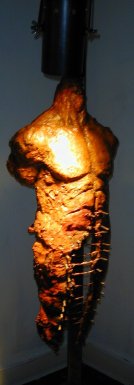
A couple more artists who deserve to be mentioned in the Hannibal Lechter art list are the very good and macabre sculptures by Stephon Senegal: this is a young artist to keep an eye on; in my opinion possibly the best sculpture in the entire show. Some other pieces by very good artists in this new trend of Lechterism are "Joroko" and also the installation "Sun Ray" by retro-recycling master Ray Jacobs.

M. Rion Hoffman really impressed me with her photography negative boxes installed along one of the main hallways. Hoffman’s boxes are delicate and have that ability to bring the viewer in for an intimate, close-up exploration of whatever story this talented artist wants to deliver. However, her large photo-collages, displayed next to her boxes, appear brutish and heavy handed by comparison, although part of me kept being re-directed from them to her brilliant boxes.

photo by Matt DunnMatt Dunn is a mother load of photographic talent with a built-in magnet to attract, discover, capture on silver gelatin film, and then show us, the really interesting, throat-clearing substrata of human society that makes Diane Arbus’ photographs look like Sears portraits. This is a master portraitist in his element.

In the glass room, Washington Glass School directors Tim Tate and Erwin Timmers have created the most professional looking set of rooms in the entire building and provided the means to discover a couple of new talents in that beautiful genre. Another fact that surfaces very quickly is that the Washington Glass School is certainly stamping its own imprimatur, its own "school brand" in a sense, upon many of our area’s young glass artists. I particularly liked the figurative "man" vessels of Michael Janis, where Janis takes Tate’s seminal idea of narrative biographical wall panels and marries it with Tate’s apothecaries (nine of which were acquired by the Renwick Alliance) to deliver a fresh, new set of ideas in glass.

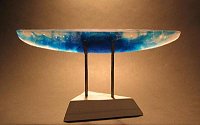
boat by Syl MathisIn these rooms I also liked Syl Mathis, who reminds us that the true beauty of glass lies mainly in its simplicity. Mathis delivers a series of pieces exploring the "boat" theme in glass. I preferred the simpler, more elegant forms by Mathis over some of the more elaborate pieces, perhaps made a bit distracting by their complex support stands and crafty materials.

Allison B. Miner is a very talented painter, and at the last Art-O-Matic, where I first discovered her small, in-your-face paintings, I singled her out as one of the best painters in that show. Miner is still one of the best painters in this show, and her talent with the brush and composition is clearly evident to the most casual observer. I do however, think that it is time for Miner to move on and push her enviable painting skills beyond the tight, close-up routine that she has come dangerously close to boxing herself in. This is a very good painter at the beginning of her career and I am sure that we are but seeing but a tiny bit of what Miner can and will deliver.crayon portrait by Barbaccia

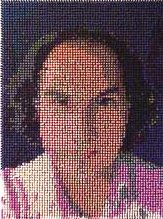
Joseph Barbaccia is another artist whom I have been observing for the last few years and this year his crayon self-portrait – literally made out of hundreds and hundreds of crayons in a postmodern pointillist style – easily qualifies as one of the best pieces of art in the whole AOM.

Barbaccia is hard to pin down as a painter, sculptor, uh... crayonist? He explores and pushes art in all dimensions.

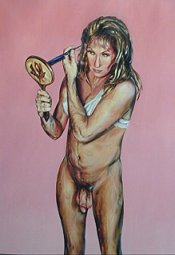
painting by DowellStaying within two dimensions, and doing a magnificent job of it are three enviably talented painters: Margaret Dowell, Michal Hunter and Jeffry Cudlin. All of these artists have that spectacular technical mastery of the brush that it is so easily dismissed by people who have never tried to mix cerulean blue with Payne’s gray and ended up with mud. Dowell’s paintings show not only extraordinary technical skills, but also a hungry sense of desire and intelligent understanding of her subjects – who are often transgender and cross dressing personages around our area.
Michal Hunter is also a technical virtuoso of the brush, with only one painting in the entire show; tucked away so far and so difficult to find, that had I not run into Hunter while she was on hallway monitor duty, I would have missed it completely. I am glad that I didn’t, as it is a very powerful work by a woman who is slowly re-affirming her once solid place in the Washington, DC art scene.

Jeffry Cudlin surprised me by delivering some very strong compositional works that are really excuses for Cudlin to use a representational subject to offer works such as "Author, Author," that are really more about the intelligent employment of color and shapes and composition. I write that he surprised me because I am not usually a big fan of these sorts of "interior" works. However, because the paintings are all about shape, color and composition, I found myself admiring them for those points, rather than for their subject matter.Scott Brooks' baby drawing

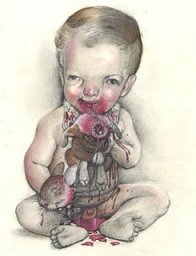
Creating a new place for himself is an illustrator named Scott Brooks, who in this new Art-O-Matic incarnation is like a strange, macabre John Currin, but can paint and draw a lot better than Currin ever learned to. A lot of people were talking about Brooks' disturbing images; this is usually a sign of success for any visual artist. Both the police and art collectors need to keep an eye on this talented artist.

But quite possibly the most talked about (well, at least the most listened to) pieces in the show are the two robotic installations by Thomas Edwards.

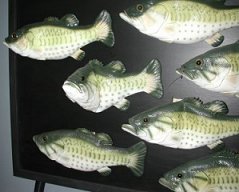
talking fish by Scott BrooksLocated on the main hallway of the fourth floor, Edwards first greets the passerby with an installation of several of those mechanical talking fish that move their heads and sing songs. He has changed the original recordings and instead of a Christmas carol, the fish now beg you to stop eating their eggs or complain that they’re dying, etc. It is funny and inventive. Edwards’ second piece is a motion sensing robotic head that follows you along a wall track and peppers you with irritating questions like "where did you get your hair done?"
Edwards’ installations are intelligent creative and they fit well right into the Hollywoodism tradition of past Art-O-Matics.

There is a lot of channeling of well-known artists in this AOM. Two artists stand out: Mark Stark channels Dan Flavin and Erin Hunter continues to somewhat channel Erik Sandberg.

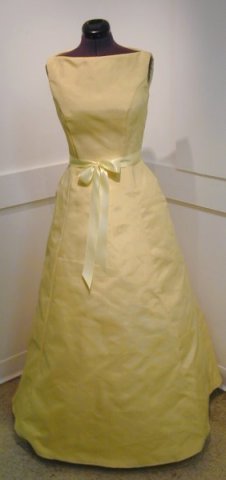
Kevlar dress by Bridget VathI also enjoyed Bridget Vath’s very inventive use of Kevlar to design and construct dresses and other clothing apparel; I suspect that Vath could start a very successful line of Kevlar clothing with good markets in Baghdad, Beirut, Bogotá, Atlanta and most of the Balkans.
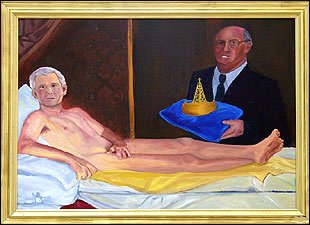
The funniest piece in the show, other than Thomas Edwards’ annoying talking fish is also one of the most famous paintings in the world.

I am referring to Kayti Didriksen’s now infamous portrait of Bush and Chaney titled "Man of Leisure: King George," where Didriksen has regurgitated Manet’s famous painting Olympia and has Vice President Chaney serving an oil well to a nude Dubya.

the famous Bush painting by KaytiThis image, a few weeks ago, at the height of the Funky Furniture controversy with the City Museum, was the most downloaded Internet image in the world.

It is a terribly funny, badly painted and highly successful work. Didriksen not only captures Bush’s likeness perfectly but also delivers an interesting expression (that’s perfect for the subject) in the much abused President (abused by a lot of AOM artists that is) and also offers a hilarious VP Chaney with a neck that seems inflamed by gout.

As with past AOM’s, a lot of artists explore the nude human figure in both paintings and photographs. This is a subject not usually seen in Washington area galleries, and I can't recall the last time that I saw an exhibition of nudes in any of our area’s museums. I noted Peggy McNutt, Shannon Chester (especially well done is "No. 10, Chair 2"), Adrienne Mills, Chris Keely, Dana Ellyn Kaufman and Candace Keegan.

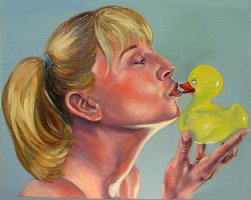
Keegan kisses rubber duckyOf these, Kaufman and Keegan both use their own bodies to deliver interesting ideas and suggestions. In Kaufman’s case, extremely acidic, caustic and pointed commentaries with provocative titles married to insane figurative paintings. In Keegan’s case, she pushes a lot of moist buttons in our psyche by playing with stereotypical Hustlerian depictions of women: See Keegan suggestively sucking on her necklace; see Keegan in pigtails offer her breasts to the viewer. However, in the end what we do see are two strong women who use their art intelligently and use the taboo nude to converse elegantly with the viewer.

There is a lot of forgettable abstraction at AOM. Two artists who stand out from the masses (and happen to be sisters) are Andrea Cybik and Jan Sherfy. Their work explores colors and action and also stands out by their very professional presentation.

In summary, I’ve been to every single Art-O-Matic ever staged, and I am in the minority opinion that they’ve improved each time, and each time they give us a most precious gift: the energy that only several hundred creative minds working together can deliver. I hope Art-O-Matic grows to become a national level open show and then grow some more and become a worldwide showcase for the world’s largest open international art exhibition and a new dagger to the heart of the 21st century salons.

Saturday, February 06, 2016

Bethesda Painting Awards Call for Artists

Competition Honors Local Artists with $14,000 in Prize Monies


The Bethesda Arts & Entertainment District is currently accepting applications for the twelfth annual Bethesda Painting Awards, a juried competition honoring four selected painters with $14,000 in prize monies. Deadline for slide submission is Friday, February 19, 2016. Up to eight finalists will be invited to display their work in June 2015 at a Gallery B in downtown Bethesda.


The competition will be juried by Dorothy Moss, Associate Curator of painting and sculpture at the National Portrait Gallery and director of the triennial Outwin Boochever Portrait Competition;  Dr. David Park Curry, Senior Curator of Decorative Arts, American Painting & Sculpture at the Baltimore Museum of Art and Megan Marlatt, Professor of Art and at University of Virginia.


The first place winner will be awarded $10,000; second place will be honored with $2,000 and third place will be awarded $1,000. A “young” artist whose birth date is after February 20, 1985 may also be awarded $1,000.


Artists must be 18 years of age or older and residents of Maryland, Virginia or Washington, D.C. All original 2-D painting including oil, acrylic, watercolor, gouache, encaustic and mixed media will be accepted. The maximum dimension should not exceed 60 inches in width or 84 inches in height. No reproductions. Artwork must have been completed within the last two years and must be available for the duration of the exhibition. 


Each artist must submit five images, application and a non-refundable entry fee of $25. 
 

For more information, or to apply online, please visit www.bethesda.org or call 301/215-6660. You may also send a self-addressed stamped envelope to the Bethesda Painting Awards, c/o Bethesda Arts & Entertainment District 7700 Old Georgetown Road, Bethesda, MD 20814.


The Bethesda Painting Awards was established by local business owner Carol Trawick in 2005. Ms. Trawick has served as a community activist for more than 25 years in downtown Bethesda. She is the former Chair of the Bethesda Arts & Entertainment District, Past Chair of the Bethesda Urban Partnership, Inc. and founder of The Trawick Prize: Bethesda Contemporary Art Awards. Ms. Trawick is the owner of an information technology company in Bethesda, Trawick & Associates.
 

Catriona Fraser, award-winning photographer, curator and juror is the non-voting Chair of the Bethesda Painting Awards. Ms. Fraser has directed the Fraser Gallery in downtown Bethesda since 2002. Ms. Fraser is also the Chair of The Trawick Prize and Director of the Bethesda Fine Arts Festival.


The eleventh annual Bethesda Painting Awards was held in June 2016. Bill Schmidt of Baltimore, MD was awarded “Best in Show” with $10,000; Thomas Dahlberg of Baltimore, MD was named second place and was given $2,000 and Cavan Fleming of Blacksburg, VA was awarded third place and received $1,000.


From award-winning theatre to independent films, downtown Bethesda’s Arts & Entertainment District is filled with inspiring artists and art venues. The Bethesda Arts & Entertainment District is managed by the Bethesda Urban Partnership, Inc., and is the producer of The Trawick Prize: Bethesda Contemporary Art Awards, Bethesda Painting Awards, Bethesda Fine Arts Festival, Bernard/Ebb Songwriting Awards, Gallery B, Studio B, Bethesda Art Walk, Dance Bethesda and Play In A Day.